
Filing your taxes accurately is essential, but mistakes happen—even to the most careful taxpayer. Whether you’ve accidentally omitted income, forgotten to claim a deduction, or made an error in reporting, correcting your tax return after submission is not only possible but relatively straightforward. The Canada Revenue Agency (CRA) offers clear procedures to help you amend your return, avoid unnecessary stress, and maintain compliance. Step One: Review Your Notice of Assessment Before taking steps to amend your return, it’s crucial to wait until you receive your Notice of Assessment (NOA). The NOA is an official statement from the CRA confirming that your tax return has been reviewed and finalized. Attempting to make corrections before the CRA processes your original return could lead to confusion, delays, or errors in the assessment process. Options for Correcting Your Tax Return Once you’ve received your NOA and confirmed that your return has been processed, you have several options to amend your tax return: 1. Online Corrections through CRA’s “My Account” The simplest and quickest way to adjust your return is online via the CRA’s “Change My Return” feature, accessible through your personal My Account portal. This online service allows you to correct returns filed for any of the last ten tax years. You can easily update income amounts, add or remove deductions, adjust credits, or report previously omitted slips such as T4s, T5s, or charitable donation receipts. Using “Change My Return” typically results in faster processing, often within two weeks, provided the CRA doesn’t require additional supporting documentation or clarification. 2. Using the ReFILE Service If you initially filed your return electronically through NETFILE-certified tax software, you can take advantage of the ReFILE service. ReFILE allows taxpayers to submit adjustments directly from their tax software for returns from recent years (typically the last three years). When using ReFILE, ensure your software supports this functionality. It streamlines the amendment process by letting you correct the information directly within the same software interface you originally used. ReFILE submissions usually see turnaround times similar to online adjustments—approximately two weeks for processing. 3. Filing Adjustments by Mail Using Form T1-ADJ For those who prefer a traditional approach or have complex amendments requiring additional documentation, the CRA provides Form T1-ADJ (T1 Adjustment Request). This form must be mailed to your appropriate tax centre, along with a clearly written explanation of each correction and copies of any relevant documents. While submitting adjustments by mail is entirely acceptable, taxpayers should anticipate longer processing times—often around eight weeks or more, particularly during busy periods such as immediately after the tax-filing deadline. Important Considerations Before Making Adjustments When preparing to correct your return, consider the following important points to ensure smooth processing: After You’ve Submitted Your Adjustment Following submission, the CRA will review your amendments and either issue a Notice of Reassessment confirming the adjustments or contact you directly if further details are required. If the CRA disagrees or cannot process your requested changes, you will receive a detailed explanation of their decision, providing you an opportunity to respond or clarify the matter further. Professional Assistance is Available While correcting minor mistakes can be straightforward, certain situations—particularly those involving multiple years, significant income adjustments, or complicated tax scenarios—benefit greatly from professional guidance. Our experienced team at Freeman & Lourenco LLP is well-versed in CRA procedures, helping clients efficiently resolve issues and optimize their tax positions. If you’re uncertain about how to proceed, contact our office to receive expert advice tailored to your specific situation. We’re committed to providing clarity, accuracy, and peace of mind throughout the amendment process.
Important Tax Filing Updates for 2025: Capital Gains Relief and Extended Deadlines
Key Updates for Individual Taxpayers (T1 Returns) Extended Filing Deadline: If you’re reporting capital gains on your 2024 T1 return, the CRA has extended the filing deadline to June 2, 2025. This extension applies to returns originally due on April 30, 2025. Filing by this new date ensures exemption from late-filing penalties and interest charges. Self-Employed Individuals: For those with self-employment income, the standard filing deadline remains June 16, 2025. However, any taxes owed are still due by April 30, 2025, to avoid interest charges. Updates for Trusts (T3 Returns) Extended Filing Deadline: The CRA has also provided relief for certain information returns: Note: Filing after these extended deadlines will result in penalties calculated from the original due dates. Capital Gains Inclusion Rate Update The federal government has deferred the proposed increase in the capital gains inclusion rate. Originally set to rise from 50% to 66.67% for gains exceeding $250,000, this change is now postponed until January 1, 2026. Until then, the inclusion rate remains at 50%. Action Steps For personalized assistance and to ensure compliance with the latest tax regulations, feel free to contact our office. Our team at Freeman & Lourenco LLP is here to support you through this tax season.

Essential Tax Strategies for Ontario Small Businesses in 2025
Effective tax planning can significantly impact your business’s profitability. Here’s a practical summary of essential tax-saving strategies specifically tailored for small businesses operating in Ontario in 2025: 1. Utilize the Small Business Deduction (For Incorporated Businesses) 2. Optimize Owner Compensation: Salary vs. Dividends 3. Income Splitting Within Family (Complying with TOSI Rules) 4. Maximize Eligible Business Expense Deductions 5. Leverage Capital Cost Allowance (CCA) & Accelerated Investment Incentive 6. Claim GST/HST Input Tax Credits 7. Retirement Planning: RRSPs and IPPs 8. Use Shareholder Loans Wisely 9. Plan for the Lifetime Capital Gains Exemption (LCGE) 10. Manage Tax Instalment Payments Final Thoughts: Effective tax planning not only reduces taxable income but enhances your business’s cash flow and growth potential. Regularly consult with your accountant to navigate changing tax legislation and optimize your business’s financial strategy. For personalized accounting and tax assistance tailored specifically to your needs, reach out to our team at Freeman & Lourenco LLP. Proudly serving small businesses in Oshawa, Whitby, Ajax, and the entire Durham Region for over 40 years, we’re here to support your business’s growth and financial health.

Renting Out a Secondary Suite? Know the Tax Implications!
Thinking about renting out your basement or a secondary suite in Ontario? Here’s what you need to know about tax implications before you hand over the keys! Report Rental Income: All rental income must be reported to the CRA and taxed at your marginal rate. Keep records of payments and lease agreements! Claim Deductible Expenses: You can deduct a portion of mortgage interest, property taxes, insurance, utilities, repairs, and advertising costs—proportionate to the rental unit’s share of the home. Capital Gains & Principal Residence Exemption (PRE): Renting out part of your home could affect your ability to claim the PRE when selling. However, if your rental space is small, has no major structural changes, and you don’t claim depreciation (CCA), you may still qualify for full exemption! Property Taxes & Ontario Incentives: Some Ontario cities offer property tax breaks for newly built rental suites. However, adding a legal secondary suite might increase your property’s assessed value and municipal taxes. Check with your local municipality for programs that reduce costs! GST/HST Considerations: New Tax Incentives & Programs: Pro Tip: Tax rules for rental units can be complex—plan ahead to maximize deductions and avoid surprises! Need personalized advice? We can help! Contact us today! Contact Freeman & Lourenco LLP at 905-576-4619 for expert tax guidance on your rental property!
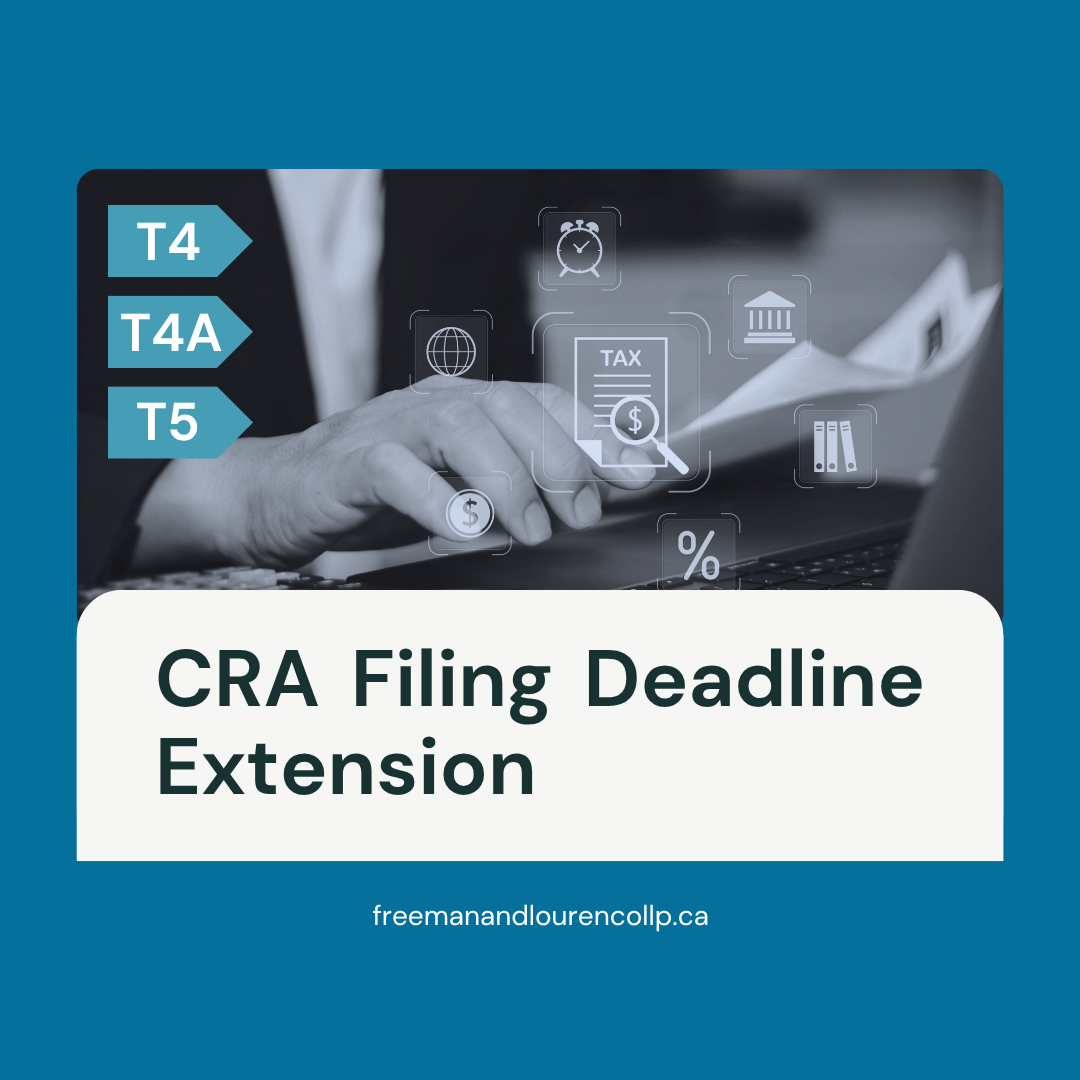
CRA Extends T4, T4A, and T5 Filing Deadlines: What Business Owners Need to Know
Attention, business owners! The Canada Revenue Agency (CRA) has extended the filing deadlines for several information returns: T4 T4A T5 These slips, originally due on February 28, 2025, can now be filed without late-filing penalties if submitted by March 7, 2025. This extension provides additional time to ensure your slips are accurate and compliant. However, it’s essential to meet the new deadline to avoid penalties. At Freeman & Lourenco LLP, our team is ready to assist you in navigating these changes, compiling necessary documents, and ensuring timely filing. Contact us today with any questions or to schedule a consultation!
